
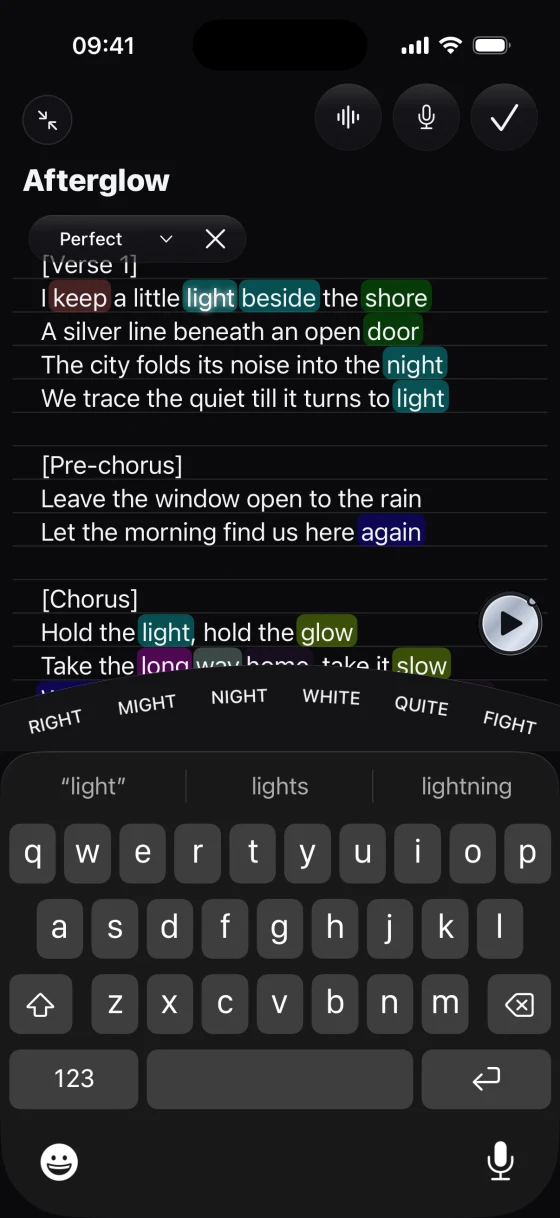
Follow the phrase across the word boundary
A multi-word rhyme uses more than one word on at least one side. Multisyllabic describes how many syllables participate. “Timing / climbing” has two matching syllables without needing a phrase. “Night train / light rain” spreads the match across words. Start with the stressed sounds, as described in the Poetry Foundation rhyme glossary, and listen through the entire ending.
- Cold air / gold hair repeats the OH sound and the ending “air,” with a different onset on the last word. It is useful as an ear exercise even if you would never use both phrases in one song.
- Last call / cracked wall is looser. The first vowel and the final “all” connect, while the consonants between them differ. The first vowel can also vary by accent.
- Back seat / track meet aligns two stressed vowels and differs at the word onsets.
Rewrite two bars without losing the scene
I caught the last train with your keys in my hand
You said you’d call when you knew where you’d land
Move the first image to the end and see if the second line can answer it:
Your keys in my coat on the last train
Two stops from home in the fast lane
Stress LAST and TRAIN, then FAST and LANE. The second vowels match closely. Now ask whether “fast lane” belongs in a train scene. Return to a single-word ending if the phrase forces an image out of the song. Record each version over the same loop. The rhyme is doing its job when the listener can still picture what happened.
Check whether the rhyme survives the performance
Tap once on each intended stress before you put the words over the beat. If a connecting word lands louder than the word you meant to stress, move the phrase earlier or leave more room before it. A pair that sounds close when read slowly can pull apart once contracted or sung. Compare the same two bars with a single-word rhyme and keep the version whose rhythm is easiest to repeat.
Find candidates for both stressed sounds
Start with the last stressed word, shortlist endings, then work backwards to the earlier stress. Use the English rhyme finder for word candidates and its limited phrase bank, or open Multi-word suggestions in Cadence’s Rhyme Inspector. For sound and placement terminology, see the types of rhyme chart.
Sources
- Rhyme glossary · Poetry FoundationChecked 2026-11-23