
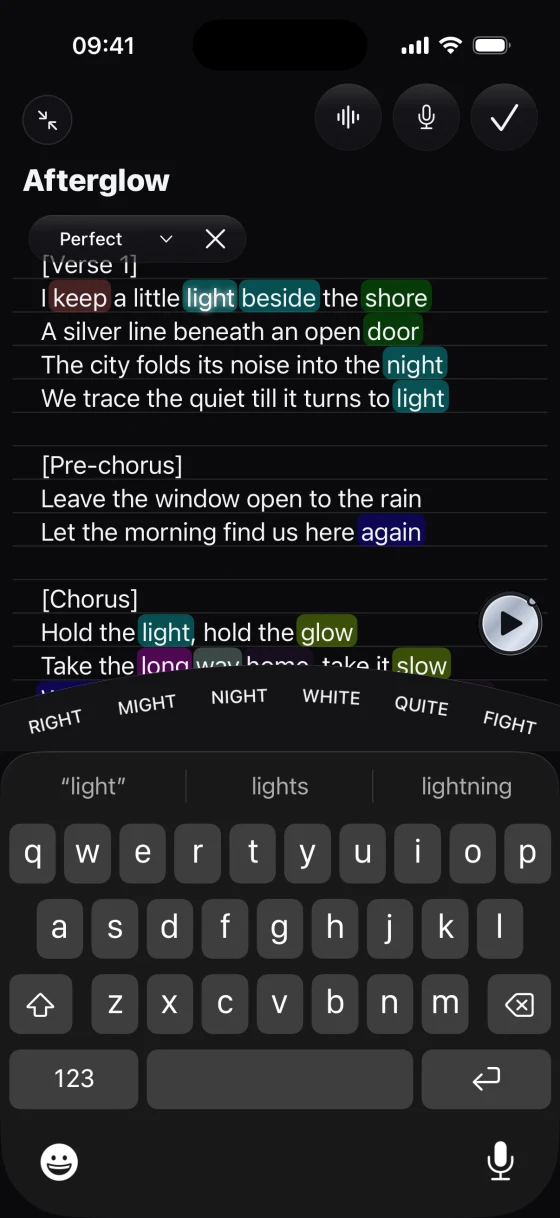
Compare rhyme types by sound and placement
The Poetry Foundation rhyme glossary distinguishes the sound relationship, the position in the line and the stress pattern. A rhyme can belong to more than one of these groups.
| Type | Example | Listen for |
|---|---|---|
| Perfect | light / night | The stressed vowel and the sounds after it match. |
| Slant or near | shape / keep | The final P matches while the stressed vowels differ. |
| Eye | love / move | The spelling looks alike, but the vowel sounds differ. |
| Internal | “The light hit the night bus.” | A match occurs inside the line. |
| End | “I dimmed the light / and waited for the night.” | The matching words sit at the ends of lines. |
| Double or feminine | timing / climbing | A stressed rhyme followed by an unstressed syllable. |
| Multi-word | night train / light rain | The sound pattern spans more than one word. |
Change one landing and hear what changes
I saw your coat by the landing light
Still on the hook at the edge of night
Read that version, then replace the second line with “Still on the hook, just out of sight.” The tight sound match stays. The image moves from time of day to something the singer almost misses. For a looser ending, try “Still on the hook where the hallway hides.” Put each version over the same two bars. Listen for which ending makes the image clearest and where the last stressed vowel lands.
Try another ending in the English rhyme finder, then judge it in your own accent.
Choose placement before adding more rhymes
Try “The light hit the night bus” as one line, then split it into “I left the light / and caught the bus that night.” The sound pair stays the same. In the first version the listener gets a quick return mid-line. In the second they wait for the next line ending. Use internal matches to add movement and choose end matches where you want the listener to remember the landing.
A single stressed ending like “light / night” releases on its last syllable. “Timing / climbing” leaves an unstressed syllable after the stressed match. Where the melody needs a held vowel and a short release, that second shape can fit more naturally. Test the words at the same tempo before choosing.
Choose what to practise next
- Multi-word rhymes for phrases that span word boundaries.
- Assonance and consonance for sound patterns inside a line.
- Perfect, slant and multisyllabic rhymes for matching stress across syllables.
- Internal rhymes and rhyme schemes for building patterns across a verse.
Sources
- Rhyme glossary · Poetry FoundationChecked 2026-11-23