
Map the end rhymes first
Label each new end sound with a letter. Four lines ending in street, rain, feet, train form ABAB; street, feet, rain, train form AABB. The letters describe recurrence, not quality. The Poetry Foundation’s rhyme glossary uses the same letter convention and distinguishes end rhyme from rhyme within a line.
Start with a simple map because it lets you hear deviations. The Poetry Foundation’s quatrain entry shows how four-line stanzas can support ABAB, AABB, ABCB, and other schemes. An original ABAB verse might read:
The shutters shake above the street (A)
I count the seconds after rain (B)
The corner shop turns off its heat (A)
I miss my stop and ride the train (B)
The scheme creates expectation, but the images and action keep it from becoming a list of rhyming words. If you cannot state what changes across the four lines, the scheme may be disguising a static verse. Write the movement in prose first, then use the pattern to organise it.
Place internal rhymes where they shape momentum
Internal rhyme connects sounds inside a line or connects an internal word with another rhyme position. It can accelerate a phrase, make a pivot memorable, or bind a long line together. In “The late bus waits while I pace by the gate,” the repeated long vowel creates a loose internal chain before the end word.
Do not sprinkle internal rhyme at random. Choose recurring positions. For example, place one near beat two and another near beat four across two bars. The listener then feels a rhythmic architecture even if the exact syllable counts vary. You can annotate a draft like this:
bar 1: x x A x / x x B
bar 2: x x A x / x x B
bar 3: x A x x / x B x
bar 4: x x A x / REST B
Bar three shifts the placements, and bar four creates space before the final answer. The variation is audible because the first two bars established a norm. Without repetition, variation has nothing to vary from.
Weave chains instead of stacking couplets
A verse can carry more than one sound family. Try an end-rhyme skeleton in one family and a lighter internal chain in another. This original four-line example uses end sounds in bold and internal echoes in italics:
I fold the receipt, take the long way home
The cold in the seat makes the night feel wide
You told me to leave, now the whole road glows
I hold to the wheel with the truth on my side
The internal old chain gives continuity while the end words alternate looser A/B families. Because the line meanings advance—from object, to sensation, to remembered speech, to decision—the technique supports a story rather than replacing one.
Longer chains are most convincing when grammar remains natural. If every line uses the same inverted sentence just to expose a rhyme, vary the scheme or move a match inside the bar. A listener notices strained syntax faster than they notice the technical achievement that caused it.
Control density across sections
Rhyme density is the amount of audible recurrence in a span of music. More density can create propulsion or pressure; less can create intimacy, clarity, or release. Contrast often matters more than the absolute count. A tightly rhymed verse can open into a chorus with one long repeated vowel. A sparse verse can lead to a hook where every short phrase answers another.
| Section job | Possible pattern | Reason |
|---|---|---|
| Set the scene | ABCB with light internal echoes | Leaves room for detail |
| Build pressure | AABB plus a repeated internal chain | Increases recurrence |
| Deliver the hook | Short perfect-rhyme pair or repeated title | Creates a clear landing |
| Change perspective | Break the established rhyme for one line | Makes the turn audible |
These are options, not rules. Prosody asks whether the pattern supports the emotional and musical purpose; Berklee’s overview of prosody is useful when deciding whether stability or instability should dominate a section.
Audit the pattern by ear
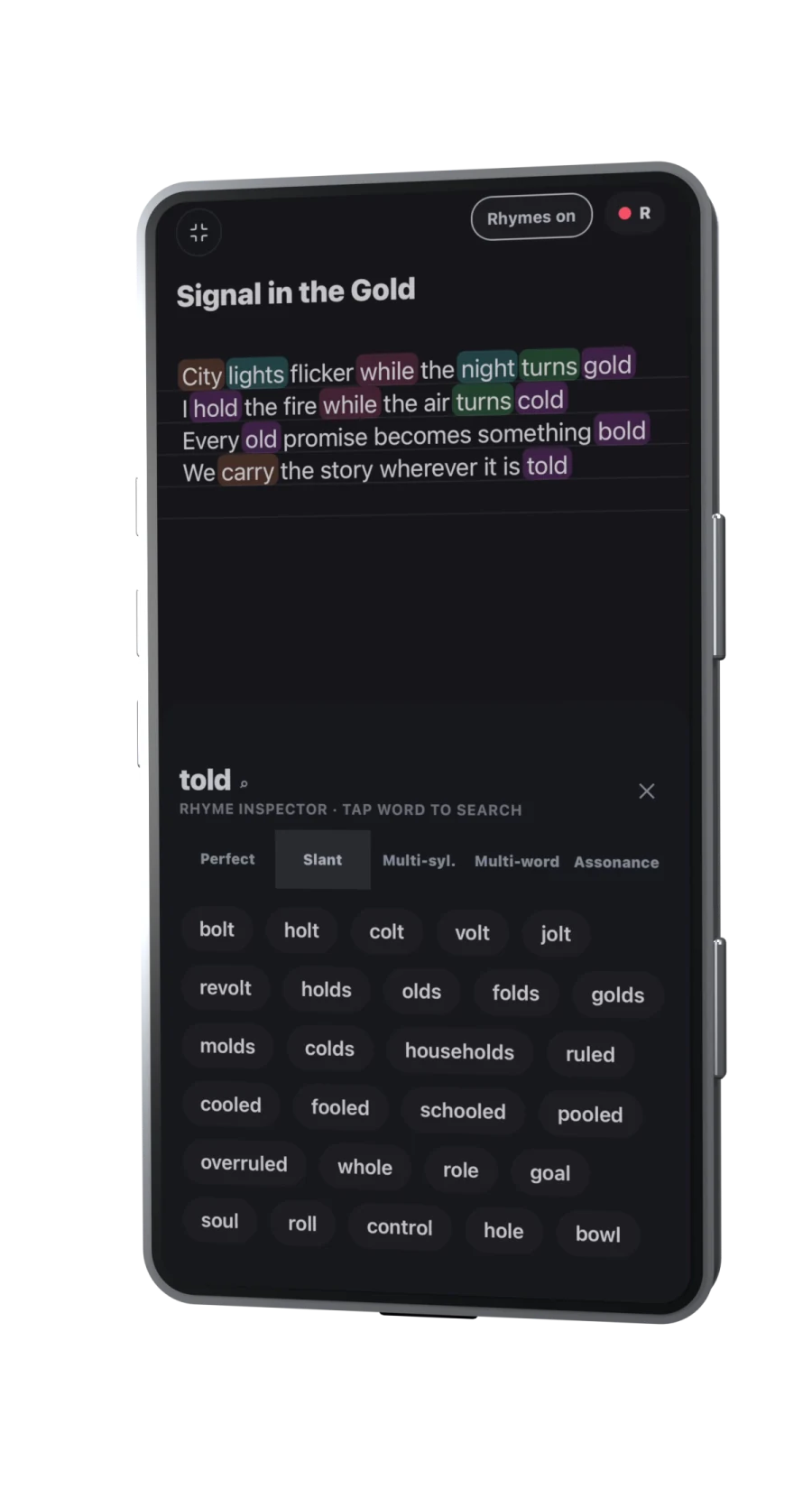
Highlight each sound family in a different colour, then perform the section without looking. Afterward, mark only the rhymes you actually heard. A rhyme may vanish because it is unstressed, swallowed, too far from its partner, or masked by the arrangement. Another may feel overemphasised because it lands at the same musical point every time.
- Read the lyric as ordinary speech and fix unnatural word order.
- Perform it over the beat and circle rushed setups.
- Mute or ignore the end words and check whether the sentences still matter.
- Restore the rhymes and vary one expected placement.
- Record two versions: precise and conversational. Keep the stronger meaning.
Cadence can highlight rhyme relationships and place multiple rhyme families beside the lyric, as shown in its rap-writing workflow. Use that visibility to diagnose a pattern, not to maximise the number of coloured words. The finished verse should sound intentional when nobody can see the markup.
Sources
- Rhyme — Poetry Foundation glossaryChecked 2026-09-17
- Quatrain — Poetry Foundation glossaryChecked 2026-09-17
- Prosody in Music and Songwriting — Berklee OnlineChecked 2026-09-17
- Cadence rap-writing workflowChecked 2026-09-17