
Listen for the beat’s invitations
Before you write a bar, loop the beat and listen without filling every gap. Mark the moments your body already notices: the kick, snare, bass change, melodic answer, drop, and any space before a section turns over. Those moments are invitations, not obligations. A vocal can reinforce them, answer them late, or deliberately leave them exposed.
Count in a way you can repeat. In a common four-beat bar, say “one and two and three and four and” while the beat plays. Then replace the count with neutral sounds such as “DA-da-da / DA-da / DA.” You are discovering a pocket: a repeatable relationship between syllables and pulse. Record three nonsense-flow passes before choosing words. The most natural pass often gives you the line lengths and landing points your lyric needs.
Tempo changes how much room a syllable has, while the same tempo can still support straight, swung, double-time, or half-time delivery. Treat BPM as a coordinate, not a command. The useful question is: where does this beat make a word feel important? Berklee’s overview of writing lyrics to music likewise treats melodic phrasing, stressed beats, rhyme placement, and song form as connected decisions.
Build a flow map before polishing rhymes
Write one line of marks for each bar. Use X for a strong landing, x for a lighter syllable, a dash for a held sound, and a slash for breath. A four-bar sketch might look like this:
1  X x x X — / x X
2  X x   X x x X
3  x X x X — / X
4  X x x x X — —
Now draft to that shape. This original example uses capitals to show the intended stresses:
RAIN on the railing, I WAIT for the green
NIGHT bus is crawling through GLASS and machine
I CAME with a question, I LEAVE with a plan
Four stops from nowhere, still KNOW who I am
The end words rhyme closely enough to create continuity, but the repeated stress shape does more of the rhythmic work. Do not count syllables alone. “Machine” has two syllables with stress at the end; “railing” has two with stress at the beginning. Swapping them into the same slot can change the feel even though the count is unchanged. The guide to syllables, stress, and flow gives a deeper method for scanning this.
Draft in layers: intent, rhythm, then rhyme
Start each section with one plain sentence that says what changes. For example: “I miss the last train, but the delay forces me to decide whether to go back.” That sentence is not a lyric; it is a compass. List concrete nouns and verbs around it—platform, rain, screen, reverse, stall, call—then draft the first four bars without demanding a perfect rhyme in every line.
On the second pass, strengthen stressed words. “I am standing at the station and I do not know” carries little weight. “Last train gone; the platform says choose” puts images and action on the landings. On the third pass, add a rhyme pattern that supports the thought. Rhyme is easier to judge once the line already has a job.
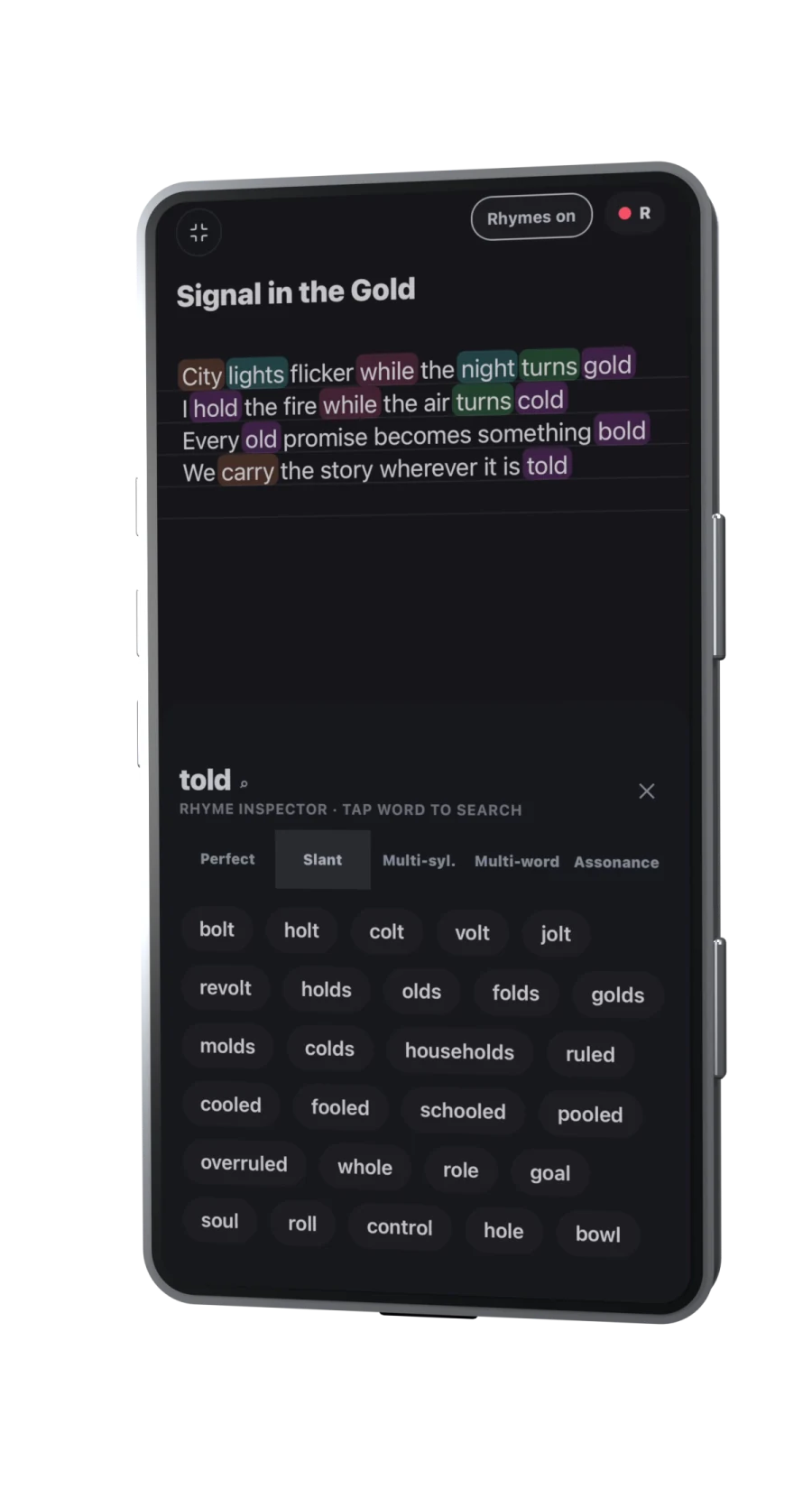
Keep alternate endings beside the verse instead of deleting them. Cadence places Perfect, Slant, Multi-syllable, Multi-word, and Assonance rhyme families beside the lyric, and its rhyme engine runs on-device; the broader Cadence product page documents those current features. A result is raw material, not a verdict. Reject any candidate that twists your sentence into something you would never say.
Test breath, consonants, and clarity out loud
Perform the verse at least five times over the actual beat. On pass one, notice only late or rushed entries. On pass two, mark breaths. On pass three, listen for consonant clusters that tangle at speed. On pass four, exaggerate the stresses. On pass five, record at performance energy.
- If you run out of breath, remove a low-value phrase before increasing speed.
- If two hard consonants collide, change the word order or leave a small rest.
- If the rhyme is audible but the sentence is not, simplify the setup.
- If every bar has identical density, create contrast by opening one bar up.
Do not mistake difficulty for quality. A dense internal pattern can be exciting, but a short line before the hook may create more impact. Likewise, rhyming on every possible subdivision can flatten emphasis because nothing is allowed to stand apart. The beat already contains information; your vocal does not have to duplicate all of it.
Revise from recordings, not memory
A written bar and a performed bar are different objects. Record a rough take, wait a few minutes, then listen once without reading. Write down only what you actually hear: the words that disappear, the line that lands early, the image you remember, and the moment your attention drops. Those notes form a better revision list than staring at the text.
Change one variable per pass. First fix timing, then breath, then wording, then rhyme detail. If you rewrite all four at once, you cannot tell which change improved the performance. Save a rough version before large edits so an energetic imperfect take is not lost to a tidier but flatter rewrite.
In Cadence, you can bring in the beat waveform, set independent A/B points, keep the lyric with vocal takes, and build a Draft Demo before moving further into the multitrack workflow. Those tools reduce app-switching; they do not decide whether a line works. Your final test remains simple: can you perform the verse repeatedly, can a listener follow its movement, and does the voice make the beat feel more complete?
Sources
- Lyric Writing: Writing Lyrics to Music — Berklee OnlineChecked 2026-09-17
- Cadence songwriting workspaceChecked 2026-09-17