
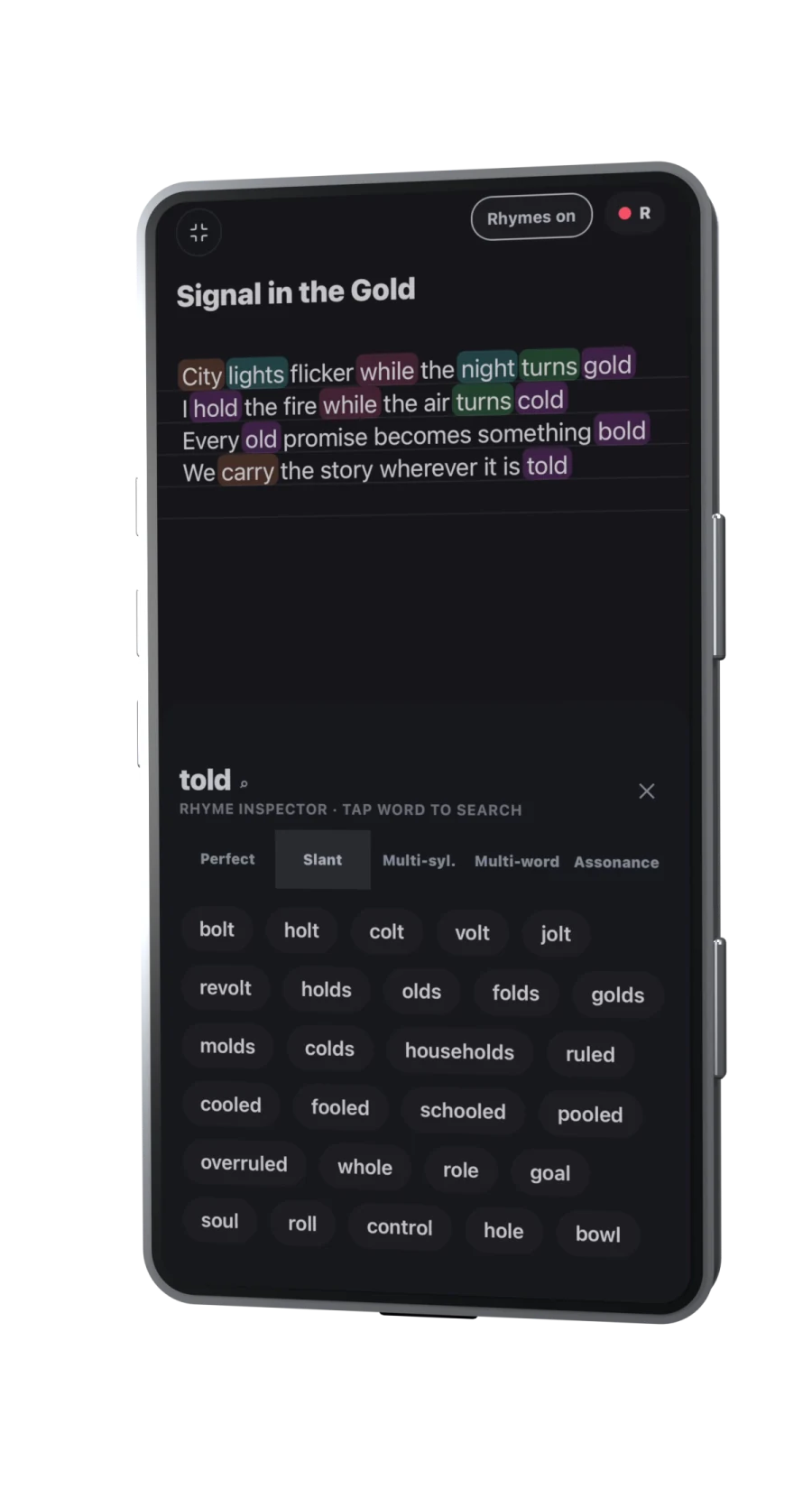
Rhyme begins at the stressed vowel
In a conventional perfect rhyme, the final stressed vowel and the sounds after it match, while the sound immediately before that vowel differs. Light/night is perfect: the long “i” and final “t” match, but the opening consonants do not. Light/flashlight repeats the whole word sound and is usually less satisfying because the difference is too small.
Spelling can mislead. Move/love looks related but uses different vowels; blue/through looks different but rhymes in many accents. The Poetry Foundation’s rhyme glossary defines rhyme through repeated syllable sounds and distinguishes end rhyme, internal rhyme, and several imperfect forms. Always say candidates aloud in the accent and delivery you intend.
Pronunciation dictionaries are useful maps, not universal authorities. CMU describes CMUDict as a US English pronunciation resource and notes that read-speech approximations do not capture every way native speakers pronounce a word. Its own CMUDict overview is a useful reminder that accent, context, singing, and performance can alter a match.
Perfect rhyme creates a firm landing
Perfect rhyme is useful when you want resolution, memorability, or a clearly audible pattern. In the original couplet “I folded the map / and slept through the gap,” the stressed vowel and final consonant match. The relation is immediate, so the second line feels closed.
That strength can become a limitation. A chain of obvious perfect rhymes may make the listener predict the wording before the thought arrives. Avoid solving this by reaching for an unrelated word. Instead, change the grammatical route to the landing. If night pulls you toward a familiar light, move the rhyme inside the line, use a less expected image, or choose a different sound family.
Also listen for identical rhyme, where the same word repeats in the same sense. Repetition can be a deliberate hook, but it does not create the same turn as two different words meeting at the sound. Name the device honestly so you can decide whether the repetition is doing structural work or merely filling the slot.
Slant rhyme keeps the door partly open
Slant rhyme—also called half or off rhyme—shares important sounds without completing the full perfect-rhyme pattern. Terminology varies, so name the actual sound relationship when precision matters. Cat/cap and light/like keep the stressed vowel but change the final consonant. Each pair is clearly related and clearly short of a perfect rhyme.
Assonance repeats a vowel sound while the surrounding consonants can differ: “wide sky, bright fire” carries the long “i” sound across four words. Consonance repeats consonant sounds while the vowel changes: blank/trunk shares the final “nk” sound but moves from the vowel in blank to the vowel in trunk. Devices can overlap—cat/cap uses assonance inside a slant-rhyme pair—but they are not interchangeable labels.
Do not label a weak match “slant” merely to defend it. Put both words into their complete lines, perform them at tempo, and ask whether the shared vowel or consonant relation is audible without explanation. Use the established pronunciation in the intended accent; do not force an unnatural vowel or swallow a consonant just to manufacture a match.
Multisyllabic rhyme matches a longer sound shape
A multisyllabic rhyme matches across two or more syllables. The number of syllables in the written word is not enough; the matching sound and stress pattern matter. Motion/ocean forms a compact two-syllable perfect rhyme in standard pronunciations because the sounds match from the stressed long “o” onward.
A phrase can extend a rhyme without becoming an exact multisyllabic match. In “paper crown / take it down,” only crown/down forms the exact one-syllable rhyme; paper/take it does not match. The full pairing is better described as an approximate multi-word or phrase slant. Build that kind of longer echo from the anchor outward:
- Choose the most important stressed vowel: crown.
- Collect exact one-syllable neighbours: down, ground, town.
- Add the preceding rhythm: paper crown.
- Search for compatible phrases such as lay it down; label the whole phrase approximate unless its earlier syllables match too.
- Treat wait around as a looser phrase slant because crown/round also changes the final consonant.
- Write complete thoughts, then keep only matches that sound natural at tempo.
A multi-word rhyme is not automatically multisyllabic, and a multisyllabic rhyme is not automatically exact. “I state it now / the paper crown” has an approximate phrase echo but vague meaning. “You built a paper crown / rain came and weighed it down” uses the same approximate phrase/slant structure more effectively because it continues the image.
Choose the rhyme strength that fits the emotion
Berklee’s discussion of prosody in songwriting frames lyric, melody, harmony, and rhythm as choices that should support the song’s central intent. Rhyme belongs in that system. A firm perfect rhyme can support certainty. A delayed or slant answer can support instability. Breaking an established pattern can make one line feel exposed.
| Need | Try | Watch for |
|---|---|---|
| Clear hook closure | Perfect end rhyme | Predictable wording |
| Conversational verse | Slant rhyme or assonance | Connections too faint to hear |
| Dense rhythmic momentum | Multisyllabic or multi-word rhyme | Syntax bent around the rhyme |
| One line to stand apart | Break or postpone the pattern | Accidental-sounding inconsistency |
Cadence separates five useful search families—Perfect, Slant, Multi-syllable, Multi-word, and Assonance—so you can compare kinds of fit rather than treating every result as equivalent. The free browser rhyme finder covers a more limited English dictionary and curated phrase bank. Both are starting points. Meaning, accent, stress, and the full performed line make the final decision.
Sources
- Rhyme — Poetry Foundation glossaryChecked 2026-09-17
- Prosody in Music and Songwriting — Berklee OnlineChecked 2026-09-17
- CMUDict 0.7b update — CMUSphinxChecked 2026-09-17
- Cadence free English rhyme finderChecked 2026-09-17